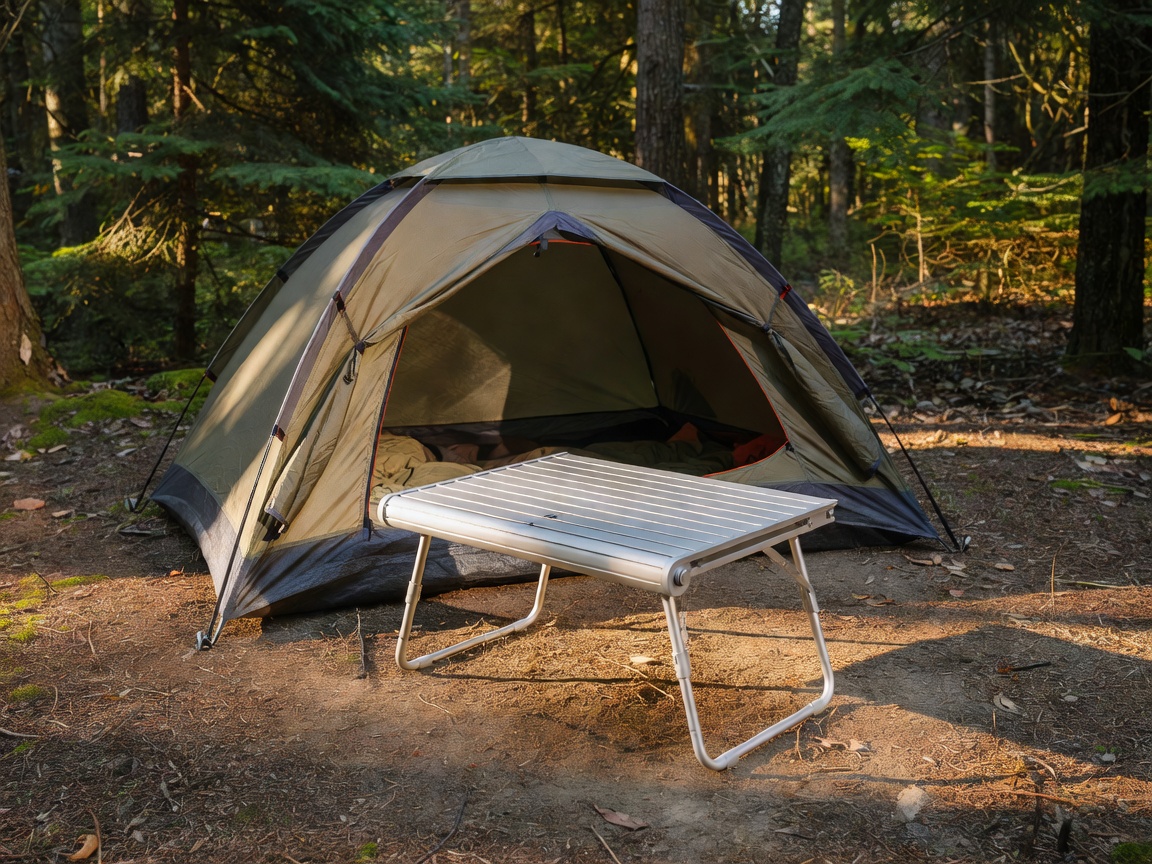
Not all outdoor dining happens on a manicured patio. For RV enthusiasts, car campers, tailgaters, and those with extremely limited balcony space, portability is the paramount feature of an outdoor table. A folding table must execute a difficult balancing act: it needs to be lightweight enough to carry with one hand, yet stable enough to safely hold boiling pots, heavy coolers, and leaning elbows.
Roll-Top Aluminum Tables
For dedicated campers, the aluminum roll-top table represents the pinnacle of portable design. Rather than folding in half like a briefcase, the tabletop consists of interlinked aluminum slats that roll up into a tight cylinder, much like a bamboo blind. The legs collapse inward like a camp chair.
Pros: Exceptional packability. They take up minimal space in a vehicle trunk. Aluminum is heat-resistant, meaning you can place a hot camp stove directly on the surface without fear of melting the table. They are also rust-proof.
Cons: Assembly takes slightly longer than a standard fold-out table. The gaps between the slats mean spilled liquids will immediately drop to the floor, and small items (like dice or stray screws) can fall through.
Blow-Molded Plastic (HDPE) Tables
These are the ubiquitous "event" tables—usually white, folding in half, with tubular steel legs. High-Density Polyethylene (HDPE) is incredibly robust and easy to manufacture.
Pros: Immediate setup time. A smooth, continuous surface makes them easy to wipe down and ideal for food prep or playing cards. They are generally the most affordable option and can handle high weight limits.
Cons: The pack size is massive; even folded in half, a 6-foot table requires significant cargo space. They are heavier than aluminum alternatives. Most importantly, HDPE is sensitive to extreme heat—placing a hot pan directly on the plastic will cause permanent bubbling or melting.
Evaluating Stability and Mechanics
A portable table is only as good as its locking mechanism. When evaluating a table, check for:
- Cross-bracing: Legs that drop straight down are prone to wobbling. Look for diagonal support arms (cross-bracing) that lock into place, forming a rigid triangle.
- Adjustable Feet: The outdoors is rarely level. Tables with independently telescoping legs or adjustable feet allow you to stabilize the surface on uneven campsite terrain, preventing disastrous spills.
- Weight Capacity: Check the manufacturer's static weight rating. A table rated for 50 lbs is fine for dining, but if you intend to set a full 60-quart cooler on it, you'll need a reinforced frame rated for 150+ lbs.
Choosing the right folding table requires assessing your exact transit method. If you have the cargo space of a large truck, a heavy-duty resin table offers unmatched prep area. If you are fitting gear into a small sedan for a weekend getaway, the compact nature of a roll-top aluminum table is well worth the slightly longer setup time.